
Recent Posts
Check in regularly to see what’s new!

Primary and Secondary Knowledge
One of the topics I have found fascinating over the past months is the concept of primary and secondary knowledge. This may be something you are familiar with, however, if you are not overly familiar with it, it can be really eye-opening when it is linked with reading, writing, and spelling.
Spaced Practice - Why is This Important?
Spaced Practice can be defined as “Repeated encounters with to-be-learned material that are spaced out in time (as opposed to recurring back-to-back)” (Kang, 2016). These repeated encounters act as an effective way to foster long-lasting learning. Teachers who include spaced repetitions into existing teaching practices provide their students with great ways to foster gains in learning without requiring added resources (Kang, 2016).
Ebbinghaus’s Forgetting Curve - How does this tie into learning?
Ebbinghaus's Forgetting Curve is a concept developed by a German psychologist named Hermann Ebbinghaus in the late 19th century. He conducted experiments to understand how we forget information over time. Ebbinghaus found that when we learn something new, we tend to forget it rapidly at first, and then the rate of forgetting gradually slows down.
What is Cognitive Load Theory, and what does it look like in action?
it's important to consider cognitive load theory when working with neurodiverse students on the dyslexic spectrum, possibly with dysgraphia or ADHD as well.

How I incorporate The Writing Revolution into tutoring sessions.
I was recently asked about how I incorporate The Writing Revolution (TWR) into my tutoring sessions. It's a great question and one that I'm happy to break down for you.

The Benefits of Home Learning for Struggling Students: A Necessity in Skill Reinforcement
The Benefits of Home Learning for Struggling Students: A Necessity in Skill Reinforcement
After reading a good article this week about whether we need to assign homework I thought I might write my two cents worth on this matter, and the role I see for homework, or home learning as I like to call it.
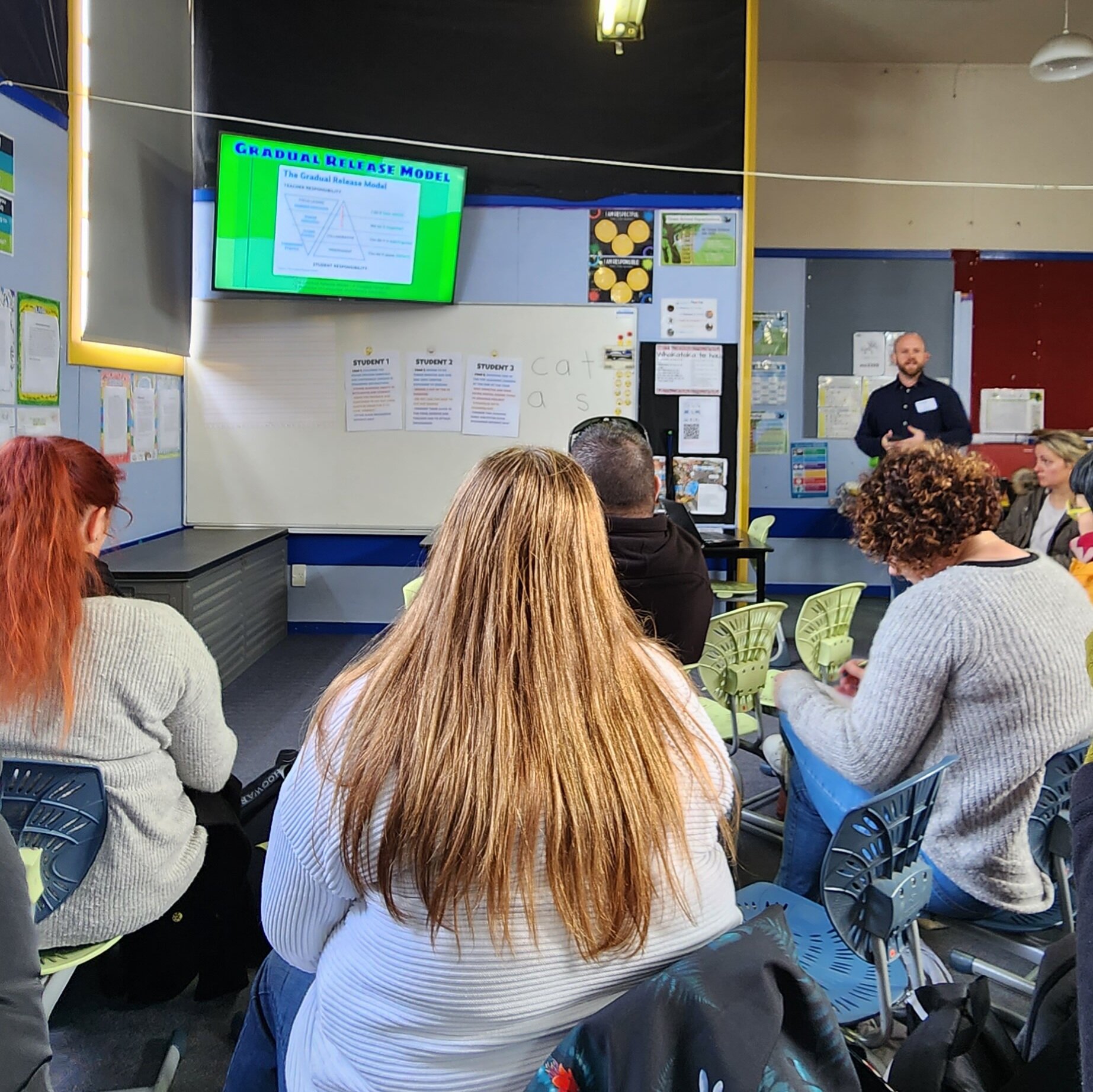
Sharing Best Practice Wellington
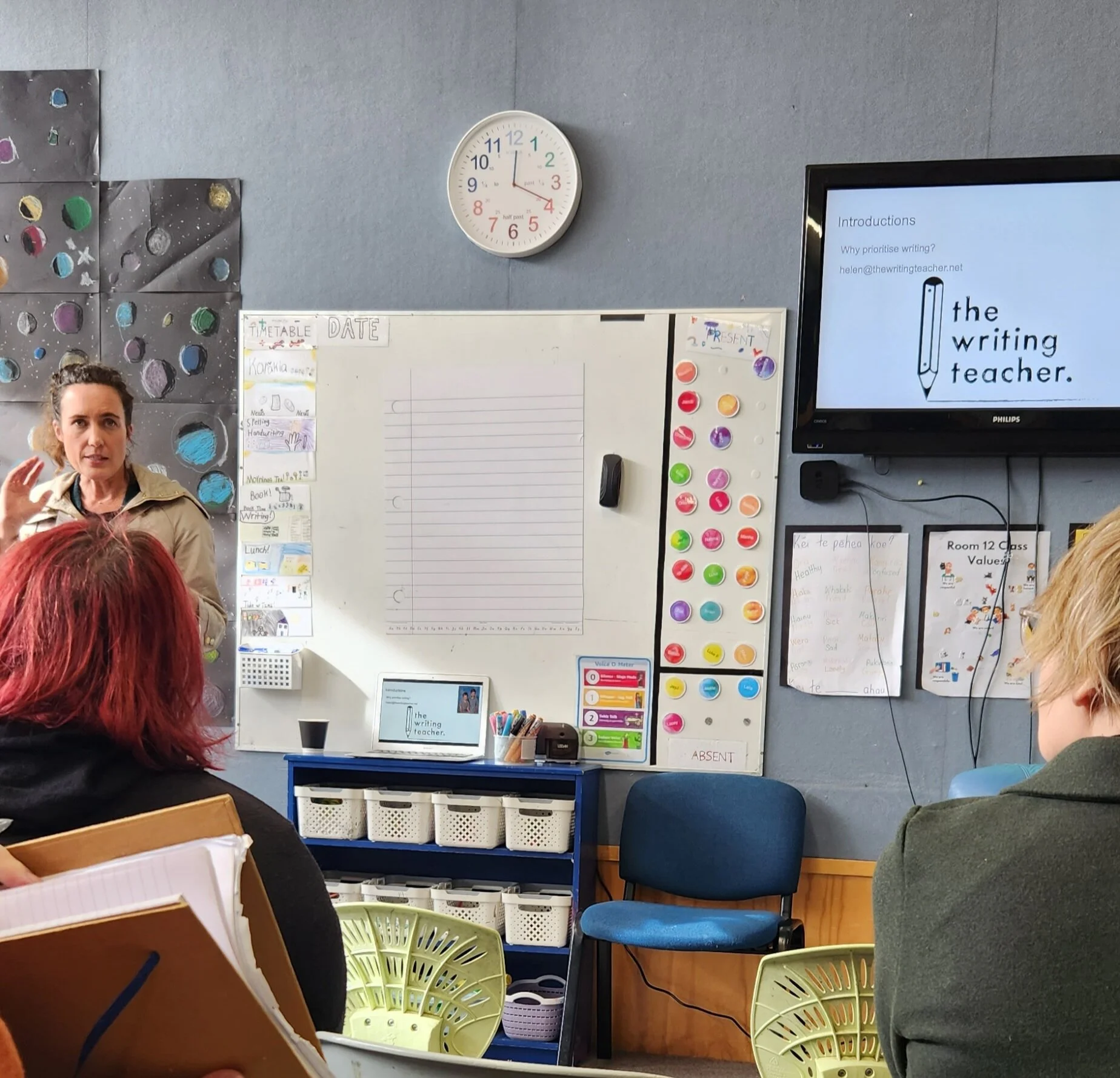
SBP Wellington - Here is post number three! Sharing information and knowledge is so important. The second workshop I attended at SBP Wellington was run by Dr. Helen Walls and was about The Significance of Handwriting to Writing (and Reading).
Sharing Best Practice Wellington
Here is my second post from SBP Wellington. I attended the breakout workshop put together by Jason Barkle, the Year 7&8 teacher at Tawa School. I chose to attend this workshop as currently I am working with several students from Year 6 through to Year 9, and I thought it would be good to explore the perspective of teaching this age group from a classroom teacher.
Sharing Best Practice Wellington.
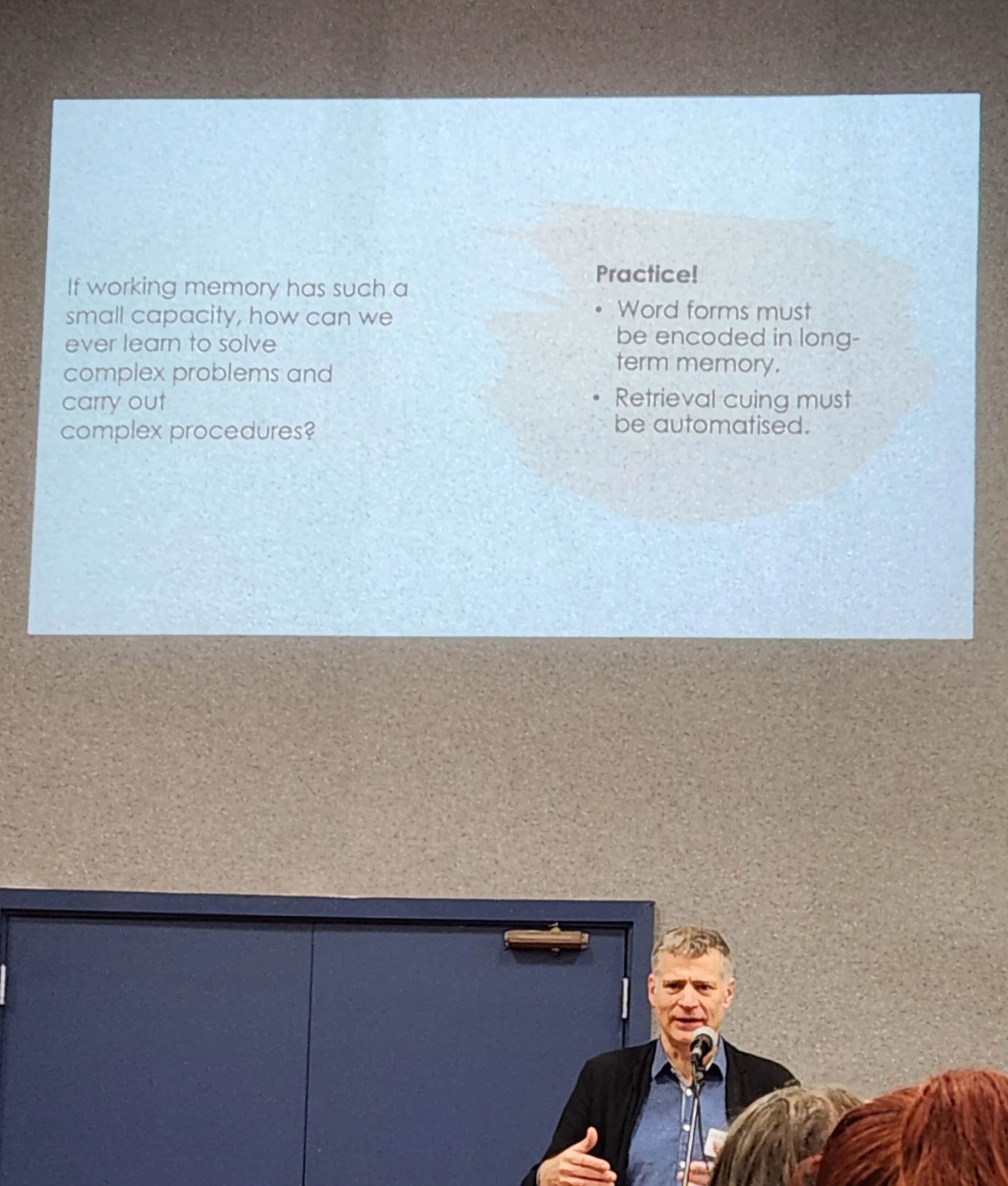
I had a fabulous day attending "Sharing Best Practice July 2023” in Wellington. Despite the freezing and rainy weather in Wellington (who would have figured!), there was a great turnout of people at Tawa School. The event ran smoothly, thanks to the hard work of the Tawa School team. The workshops were fantastic and presented by passionate teachers, and the keynote speakers were exceptional.
Interference
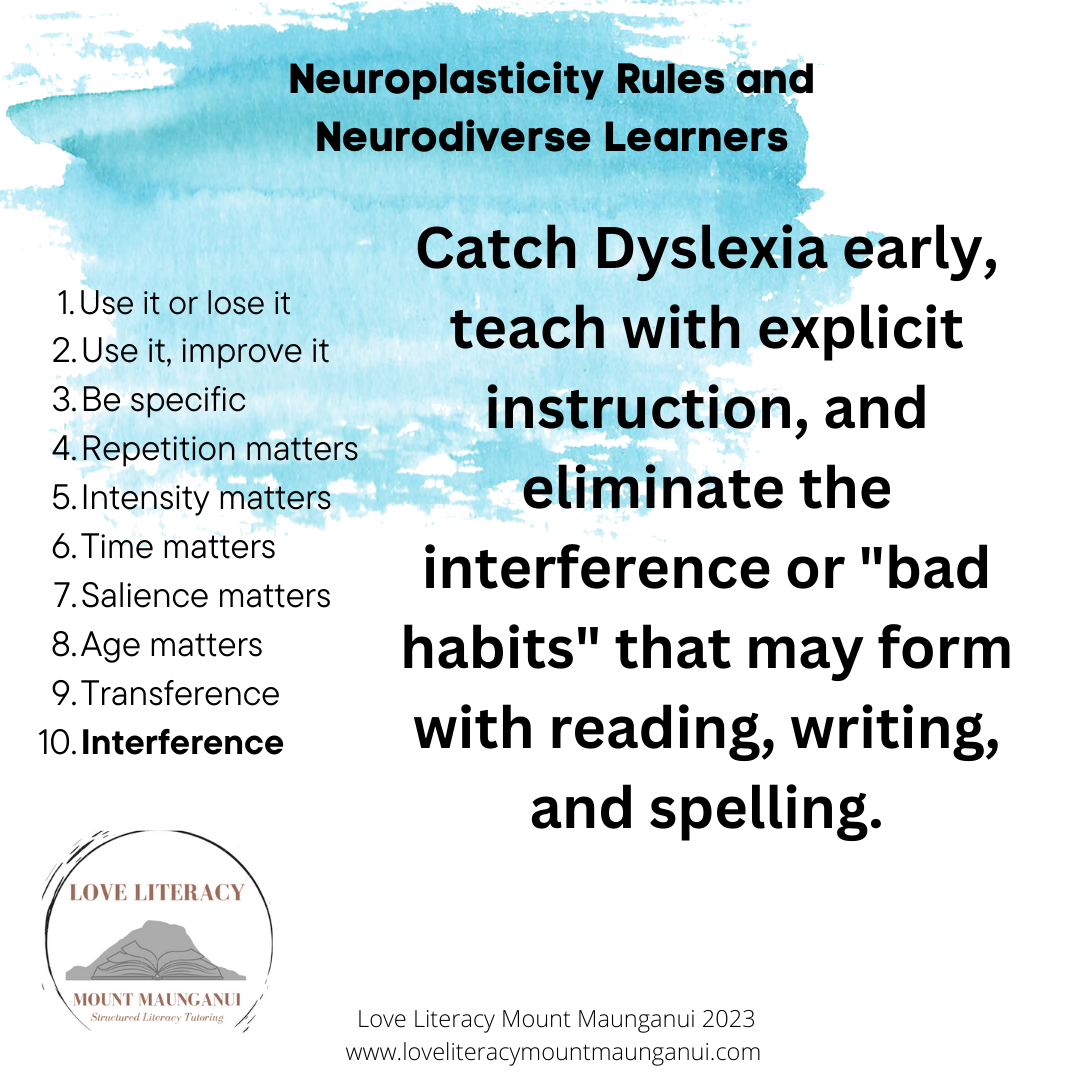
Neuroplasticity Rule #10 Interference.
Here we are in the final week of looking at the ten rules of Neuroplasticity, through the lens of a dyslexic or neurodiverse learner. The final rule is interference. Unfortunately, changes in the brain that result in bad habits, may interfere with learning good habits (https://www.cfimove.org/).
Transference
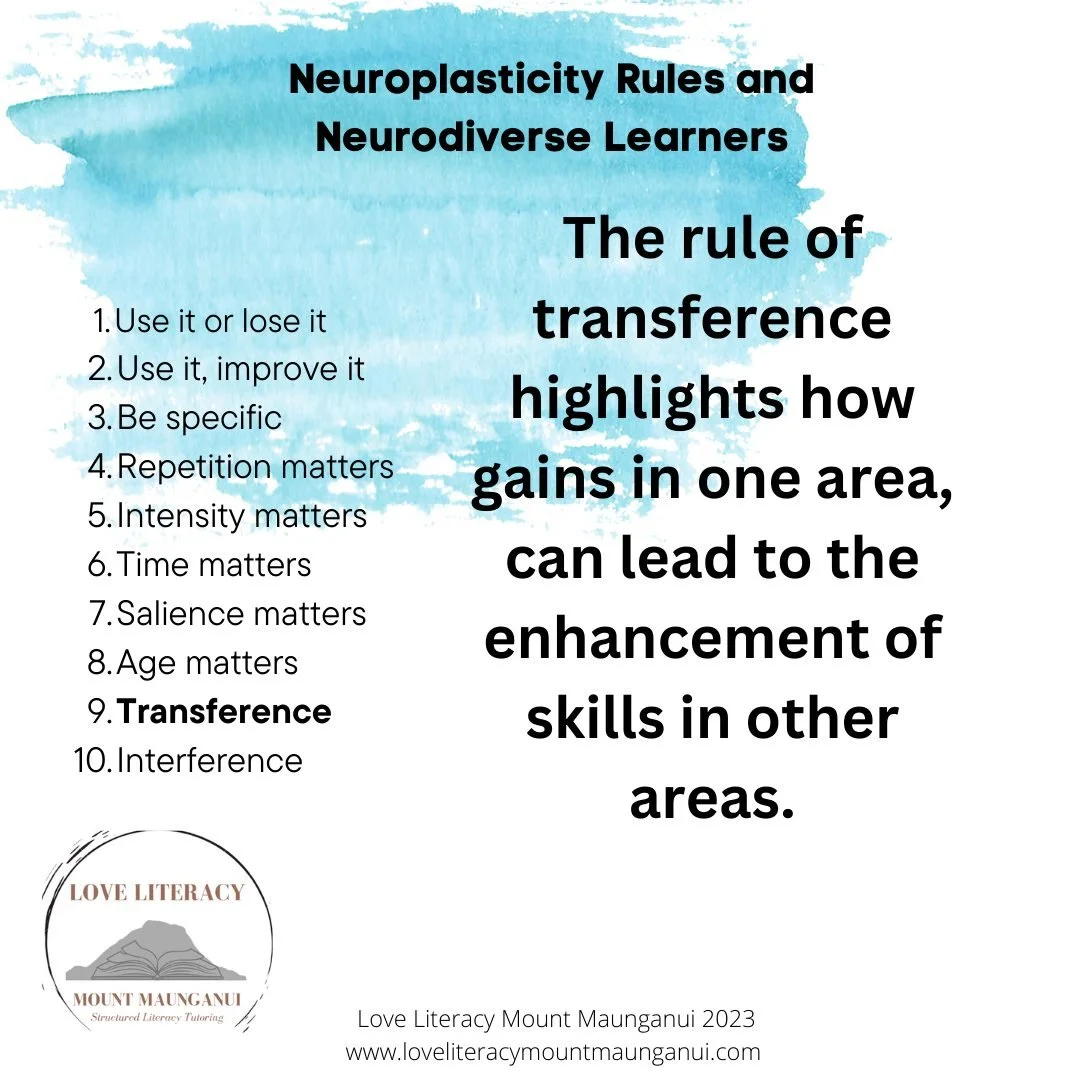
This week we look at the Neuroplasticity Rule of ‘transference’. Transference can be described as follows: "Plasticity (change) in response to one training experience, can enhance acquisition of similar behaviors." (Neuroskills.com, 2023).
Age Matters
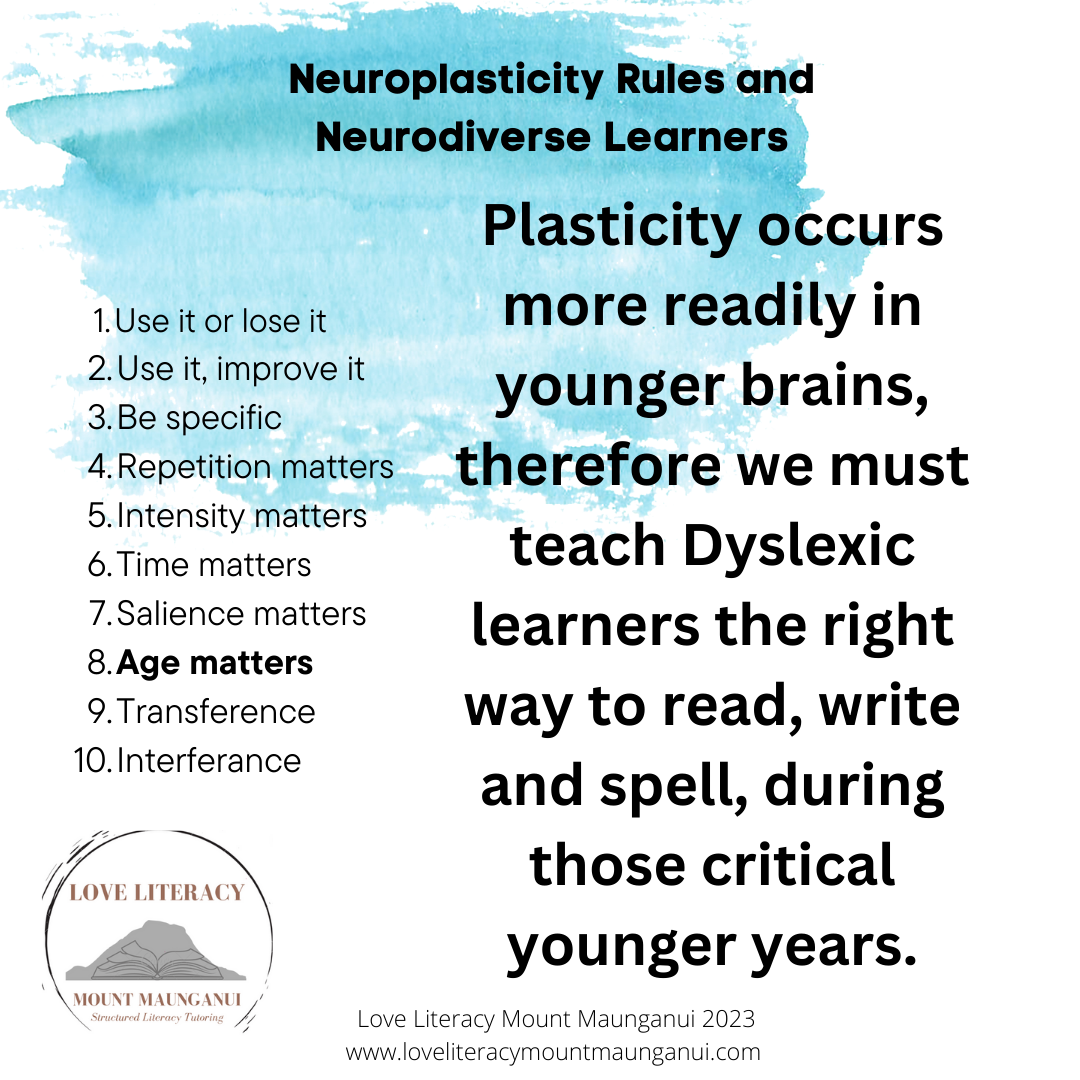
Neuroplasticity Rule #8 - Age matters
This week we look at Neurplasticity Rule number eight, I look at how Age Matters for Dyslexic and Neurodiverse learners when learning to read, write and spell. Age really does matter, and this is because any type of change brought about by teaching something in a specific way, occurs more readily in younger brains.
Salience Matters
Neuroplasticity Rule #7 - Salience Matters
This week I’m looking at Neuroplasticity Rule number 7 - Salience Matters. This post is short and sweet! I hope you have enjoyed the various posts I have put up over the weeks, I've really enjoyed reading into Neuroplasticity Rules and how these can be looked at through the lens of a Dyslexic Learner. I've loved growing my understanding of why brains learn the way they do, and it's sparked more of an interest in me with just how amazing our brains really are!
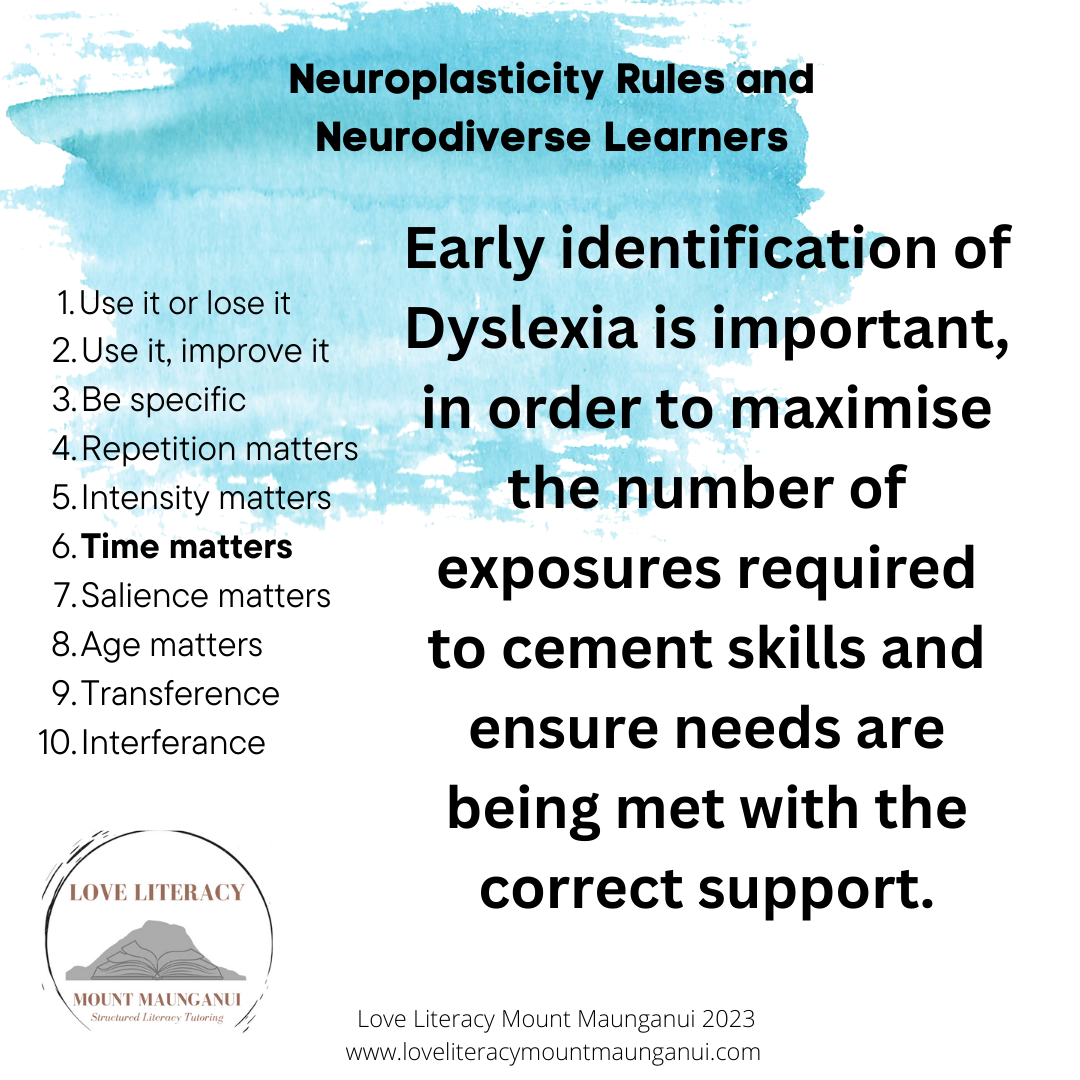
Time Matters for Neurodiverse Learners.
The sooner a learner is identified as having neurodiverse needs, whether they be dyslexia or dysgraphia or ADHD for example, the sooner the correct supports can be put in place to ensure success for that learner.
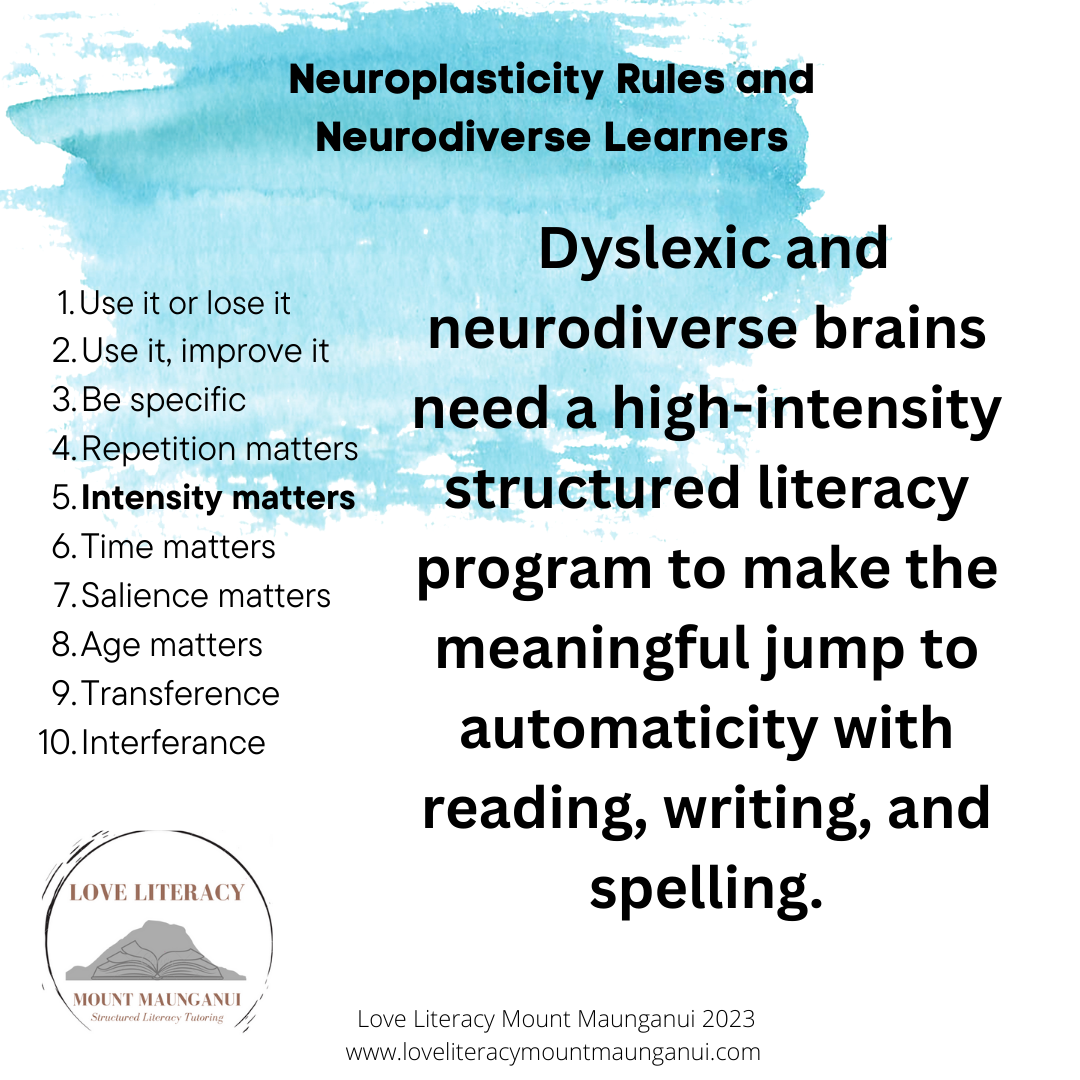
Intensity Matters
In Neuroplasticity Principle number 5, we look at how intensity matters in teaching reading, writing, and spelling in order to make the necessary changes and cement skills for automatic retrieval for dyslexic and neurodiverse learners (and all learners!).
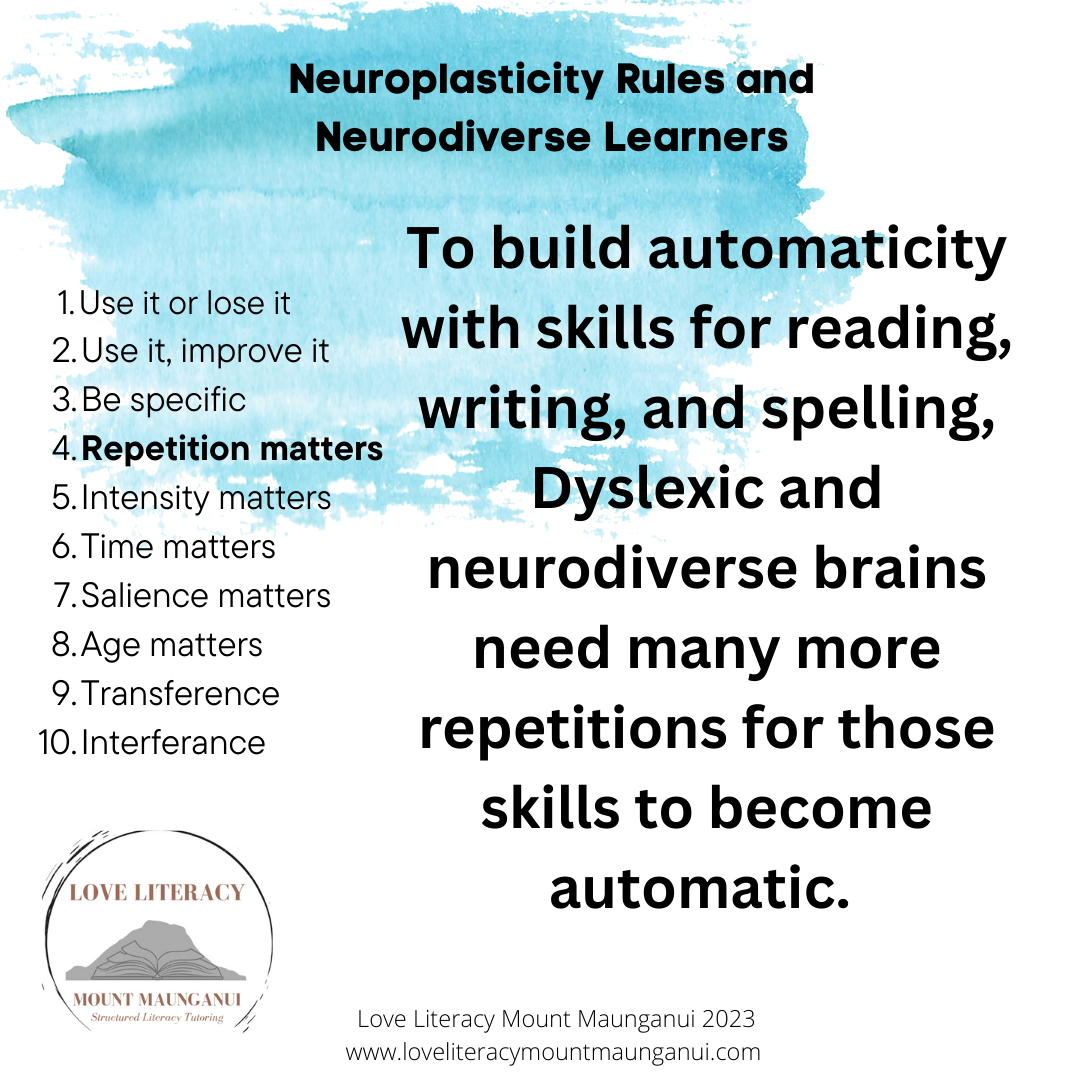
Repetition Matters
Neuroplasticity Rule #4
If we want to elicit change (or plasticity), this will require enough repetition (2023, cfimove.org).

I’m on a podcast…
I’m on a podcast! Arti from Human Chapters has given me a voice across social media. Listen to how having a Dyslexic, Dysgraphic and Dyscalculic son changed my life and put me on my path to becoming a literacy tutor.
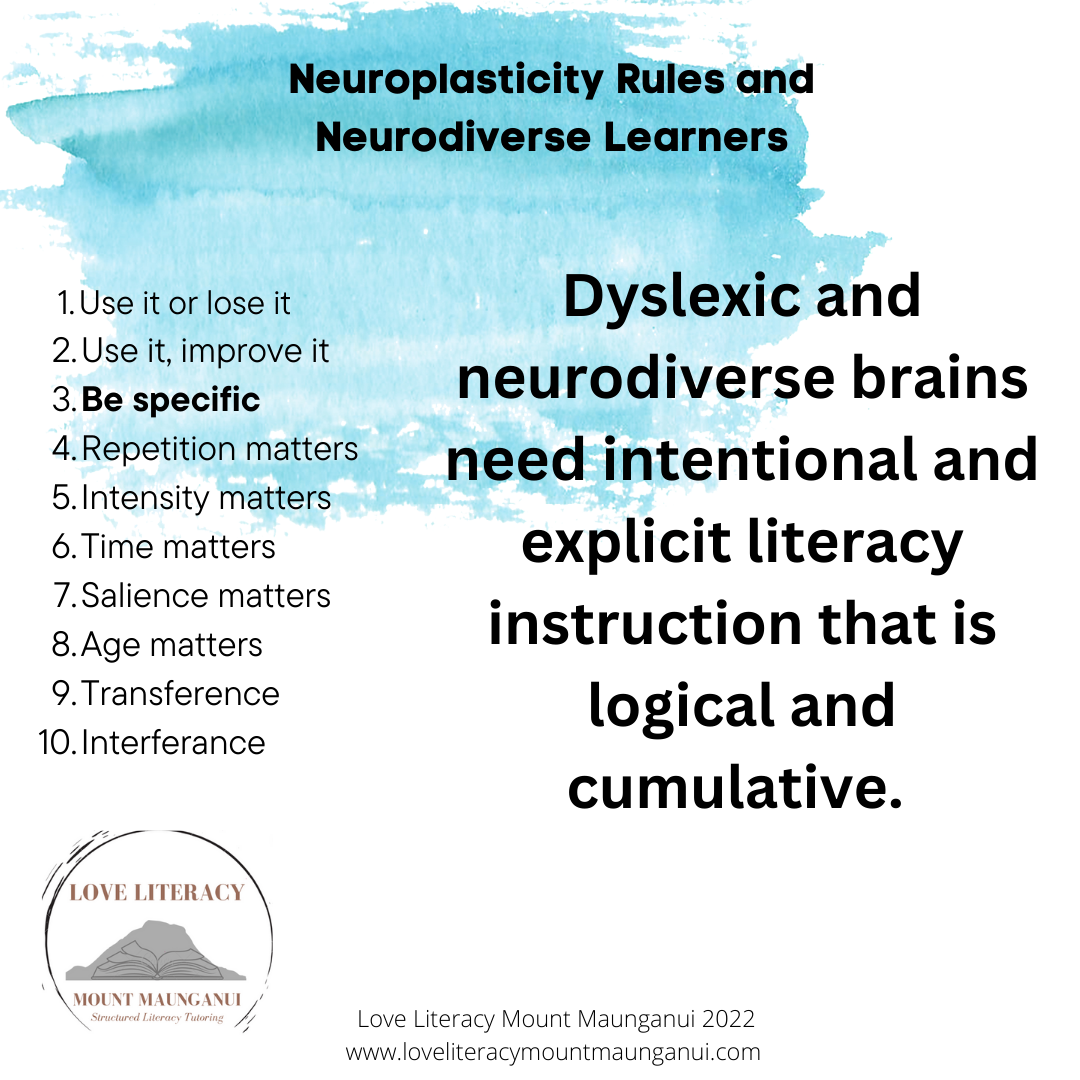
Be specific.
Neuroplasticity Rule #3 - Be Specific!
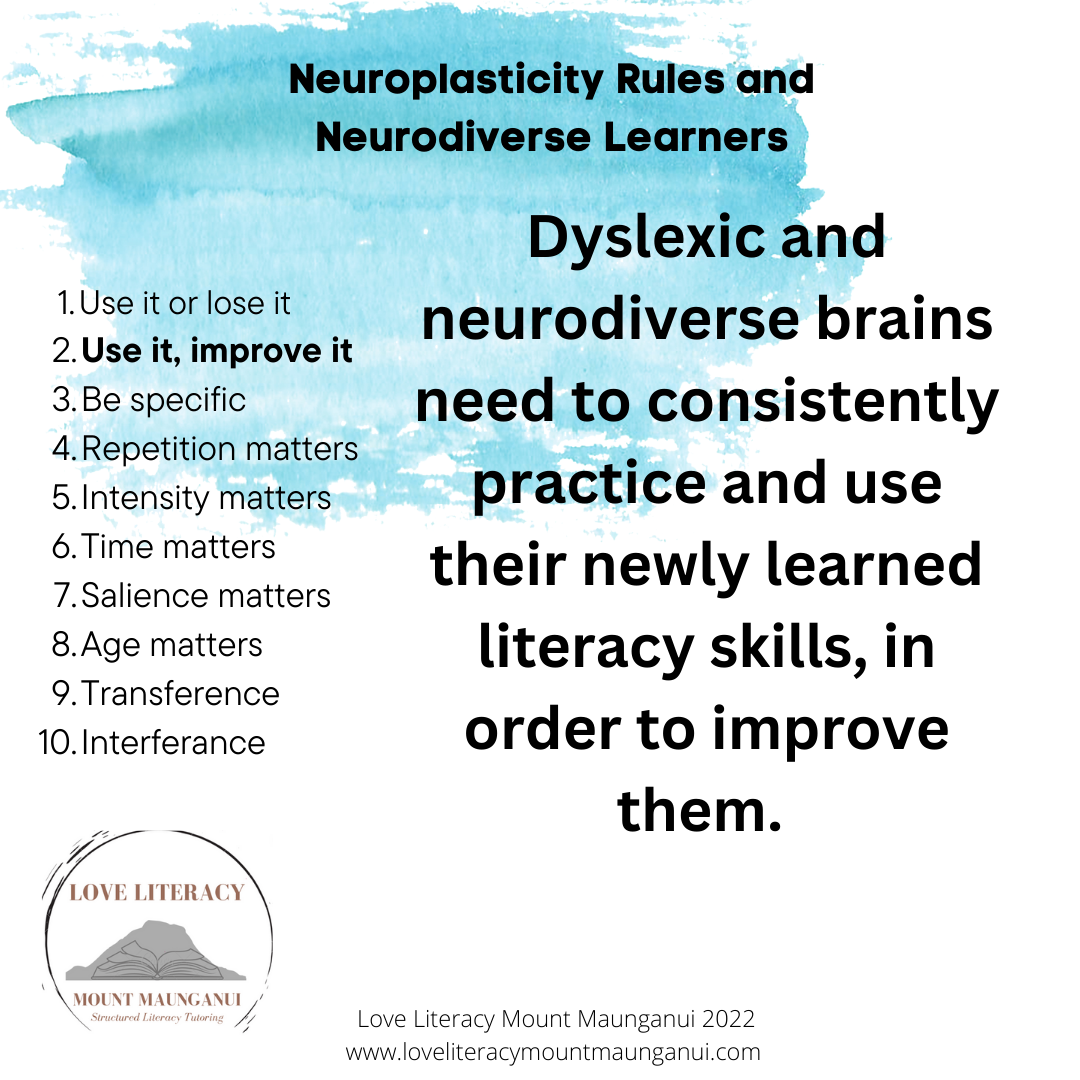
Use it, to improve it.
Neuroplasticity Rule #2 - Use it to improve it.
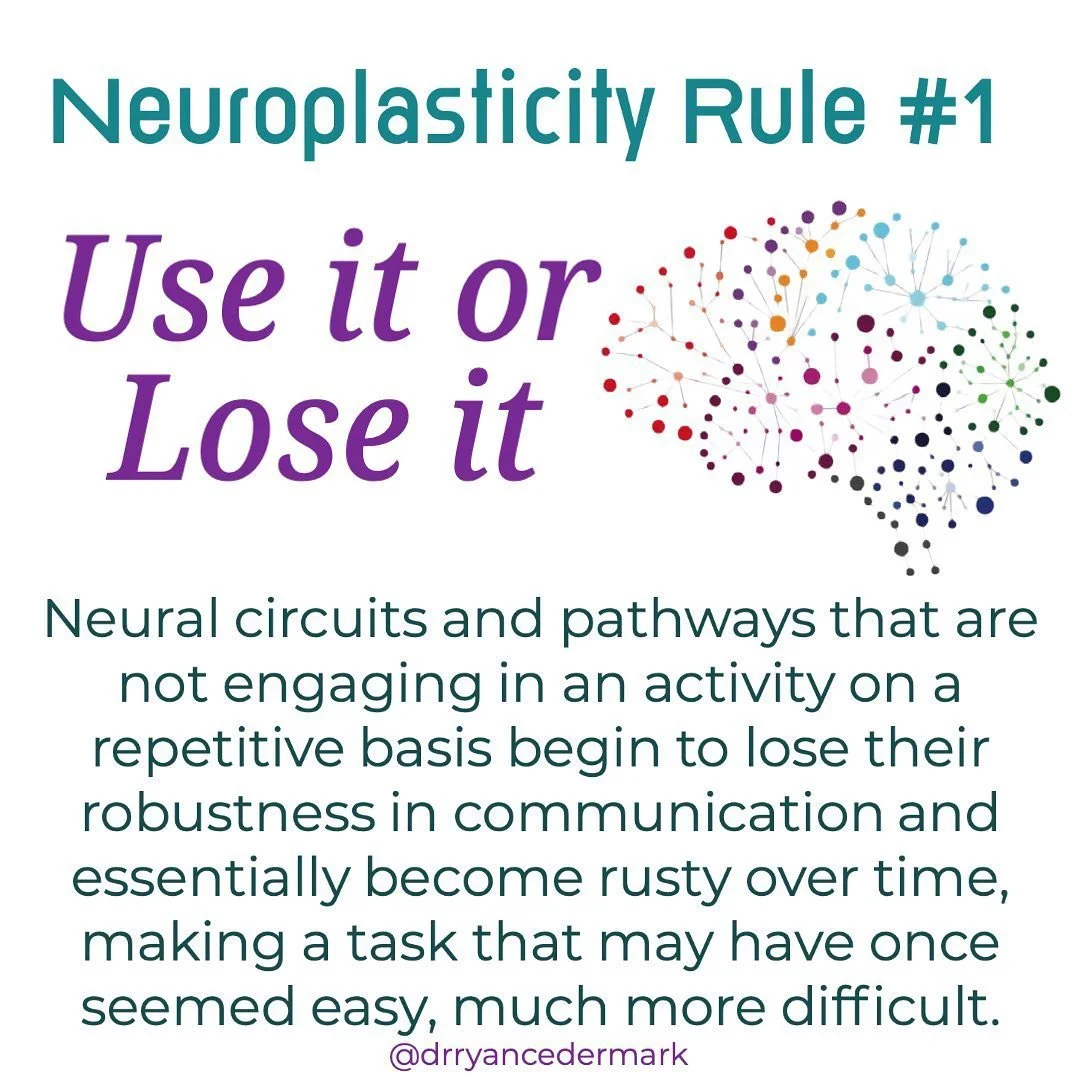
Use it, or lose it.
Neuroplasticity Rule #1 - Use it or Lose it!