 Image 1 of 1
Build reading, vocabulary and writing around knowledge that matters
Looking for meaningful topics that can bring reading, vocabulary, discussion and writing together?
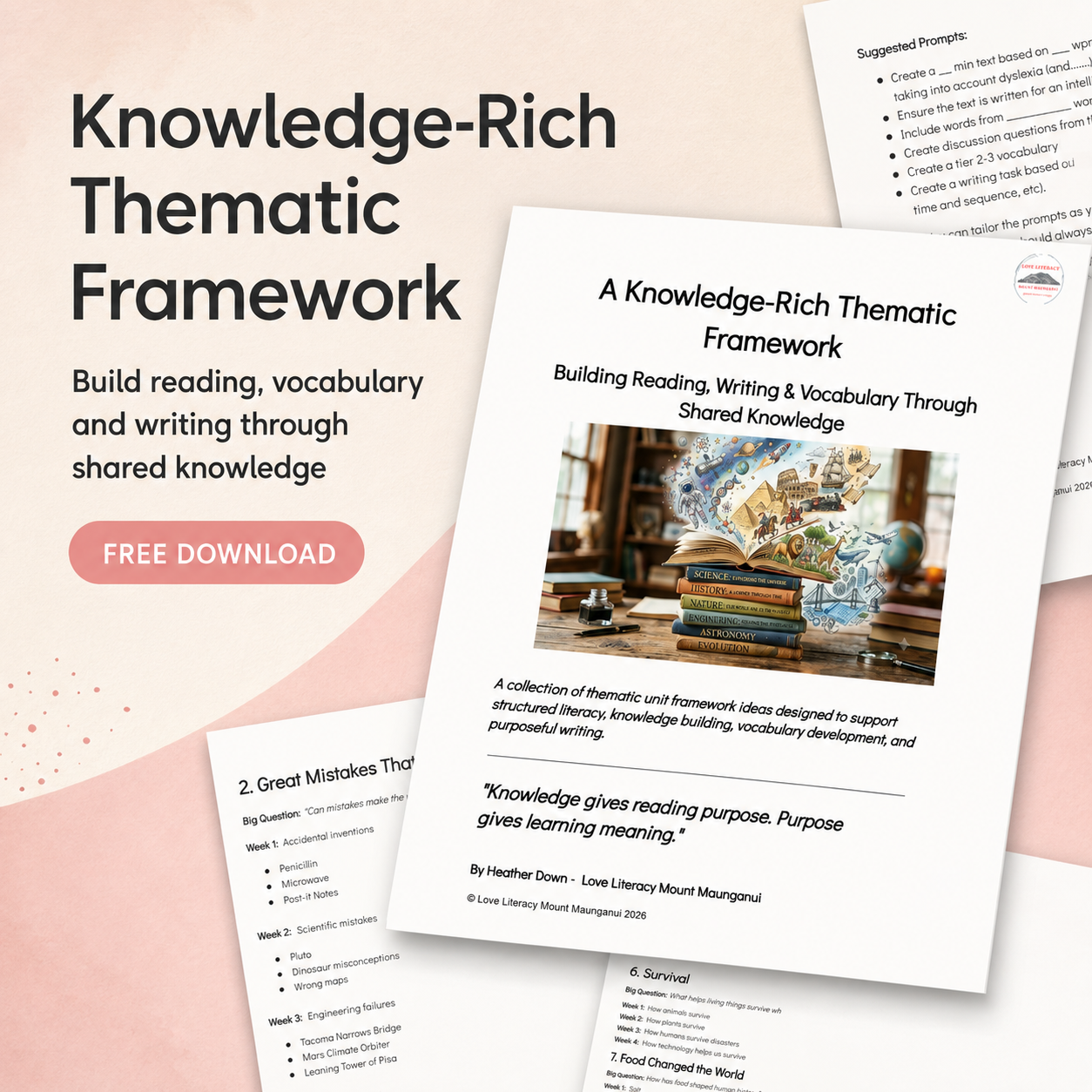
This free resource contains ten knowledge-rich thematic frameworks designed to help teachers and tutors plan connected literacy learning around engaging science, history, technology, society and the natural world.
Each theme is organised around one compelling big question and four weekly topics. The ideas can be used to develop reading texts, explicitly teach vocabulary and morphology, support rich discussion, and give students something meaningful to write about.
Rather than treating reading and writing as isolated activities, these frameworks encourage students to remain with a topic long enough to build knowledge, make connections and communicate increasingly complex ideas.
You’ll find ten four-week themes, including:
Invisible Forces
Great Mistakes That Changed History
How Humans Changed Earth
Hidden Jobs
Amazing Materials
Survival
Food That Changed the World
Nature’s Superpowers
The Science of Sport
How Societies Grow, Change and Endure
The first two themes provide more detailed examples of possible content and writing progressions. The remaining themes offer flexible weekly topic outlines for you to research, develop and adapt to your learners.
The resource also includes practical suggestions for:
connecting reading, writing and vocabulary
incorporating phonology, spelling or morphology
introducing important concept words
creating text-based discussion and writing tasks
using AI prompts to help develop appropriately sized reading texts and supporting activities
This resource may be useful for:
classroom teachers
literacy intervention teachers
private tutors
homeschool educators
anyone wanting to build literacy through shared knowledge
This is a collection of planning ideas and thematic starting points. It is not a complete literacy programme, a set of ready-to-teach lesson plans or a prescribed curriculum sequence.
It does not include completed reading texts, assessments, detailed vocabulary instruction or full weekly lesson plans. Teachers and tutors will need to research each topic, select reliable sources, create or locate suitable texts, and adapt the content to their learners and curriculum context.
The ideas reflect my professional experience as a literacy intervention teacher and the approaches that have engaged and supported my students. The resource has not been formally researched or independently validated.
The included prompts may help you create initial drafts of texts, questions and learning activities. Any AI-generated content should be treated as a starting point.
Always check:
factual and cultural accuracy
the reliability of the information
sentence and vocabulary demands
suitability for the learner’s age and background knowledge
alignment with the intended spelling, morphology or writing focus
whether the text represents people, histories and cultures respectfully
A student’s oral reading rate can help you estimate an appropriate text length, but it does not determine whether a text is suitable or accessible. Reading accuracy, decoding knowledge, vocabulary, background knowledge, language comprehension and individual learning needs must also be considered.
Do not enter students’ names or other identifying information into an AI tool.
Use these themes as a springboard. Follow your students’ questions, select the knowledge that matters most, and adapt the pacing and level of support to your teaching context.
Download your free copy and begin building connected literacy learning through knowledge.
“Knowledge gives reading purpose. Purpose gives learning meaning.”
— Heather Down, Love Literacy
Build reading, vocabulary and writing around knowledge that matters
Looking for meaningful topics that can bring reading, vocabulary, discussion and writing together?
This free resource contains ten knowledge-rich thematic frameworks designed to help teachers and tutors plan connected literacy learning around engaging science, history, technology, society and the natural world.
Each theme is organised around one compelling big question and four weekly topics. The ideas can be used to develop reading texts, explicitly teach vocabulary and morphology, support rich discussion, and give students something meaningful to write about.
Rather than treating reading and writing as isolated activities, these frameworks encourage students to remain with a topic long enough to build knowledge, make connections and communicate increasingly complex ideas.
You’ll find ten four-week themes, including:
Invisible Forces
Great Mistakes That Changed History
How Humans Changed Earth
Hidden Jobs
Amazing Materials
Survival
Food That Changed the World
Nature’s Superpowers
The Science of Sport
How Societies Grow, Change and Endure
The first two themes provide more detailed examples of possible content and writing progressions. The remaining themes offer flexible weekly topic outlines for you to research, develop and adapt to your learners.
The resource also includes practical suggestions for:
connecting reading, writing and vocabulary
incorporating phonology, spelling or morphology
introducing important concept words
creating text-based discussion and writing tasks
using AI prompts to help develop appropriately sized reading texts and supporting activities
This resource may be useful for:
classroom teachers
literacy intervention teachers
private tutors
homeschool educators
anyone wanting to build literacy through shared knowledge
This is a collection of planning ideas and thematic starting points. It is not a complete literacy programme, a set of ready-to-teach lesson plans or a prescribed curriculum sequence.
It does not include completed reading texts, assessments, detailed vocabulary instruction or full weekly lesson plans. Teachers and tutors will need to research each topic, select reliable sources, create or locate suitable texts, and adapt the content to their learners and curriculum context.
The ideas reflect my professional experience as a literacy intervention teacher and the approaches that have engaged and supported my students. The resource has not been formally researched or independently validated.
The included prompts may help you create initial drafts of texts, questions and learning activities. Any AI-generated content should be treated as a starting point.
Always check:
factual and cultural accuracy
the reliability of the information
sentence and vocabulary demands
suitability for the learner’s age and background knowledge
alignment with the intended spelling, morphology or writing focus
whether the text represents people, histories and cultures respectfully
A student’s oral reading rate can help you estimate an appropriate text length, but it does not determine whether a text is suitable or accessible. Reading accuracy, decoding knowledge, vocabulary, background knowledge, language comprehension and individual learning needs must also be considered.
Do not enter students’ names or other identifying information into an AI tool.
Use these themes as a springboard. Follow your students’ questions, select the knowledge that matters most, and adapt the pacing and level of support to your teaching context.
Download your free copy and begin building connected literacy learning through knowledge.
“Knowledge gives reading purpose. Purpose gives learning meaning.”
— Heather Down, Love Literacy